How Can Green Energy Improve Remote Solar Pumping Efficiency?
Remote pumping sites often face a basic problem: water demand does not always match power availability. Farms, irrigation projects, livestock facilities, and isolated water stations may be far from a stable electrical grid. green energy solutions can reduce this dependence by combining solar generation with suitable pumping equipment and motor control.
However, solar panels alone do not determine system efficiency. Pump size, motor speed, pipe resistance, water storage, and daily operating schedules also affect performance. Well-designed solar pumping systems coordinate these factors so that available solar energy can be converted into useful water output with fewer avoidable losses.
Solar Generation Must Match Water Demand
Solar output changes throughout the day. Generation usually rises in the morning, reaches higher levels around midday, and decreases later. Cloud cover can also create short-term fluctuations. Pumping equipment must therefore operate under power conditions that are not always constant.
The first design step is to calculate actual water demand. Engineers should consider required daily volume, flow rate, total dynamic head, well depth, pipe length, and storage capacity. Selecting a pump only by rated power can create poor matching between generation and hydraulic demand.
Water tanks can improve operating flexibility. Instead of requiring the pump to run whenever water is consumed, the system can pump during periods with stronger solar generation. Stored water can then support demand later in the day.
Motor Speed Affects Overall Energy Use
Fixed-speed motors may not use changing solar power efficiently. When available power drops, the system may need to reduce output rather than repeatedly stop and restart. Variable speed control provides a practical way to adjust pump operation according to available energy.
For centrifugal pumps, lower motor speed generally reduces flow, head, and power demand. The exact relationship depends on the pump curve and the hydraulic system. Engineers should therefore evaluate both electrical and mechanical conditions before setting operating frequencies.
Selecting a suitable drive also matters. Cooperation with a Variable Frequency Drive manufacturer can help project teams compare motor ratings, input voltage, control methods, overload capacity, and protection requirements before installation.
Correct acceleration and deceleration settings can also reduce unnecessary stress on the motor and pump. Current limits, minimum frequency settings, and operating ranges should be configured according to the actual pump rather than copied from another project.
Electrical Control Supports Stable Operation
Remote pumping stations can be difficult to access for maintenance. Electrical control equipment should therefore be selected with operating stability, protection, and system integration in mind. Motor overload, unsuitable wiring, voltage variation, and electromagnetic interference can all affect operation.
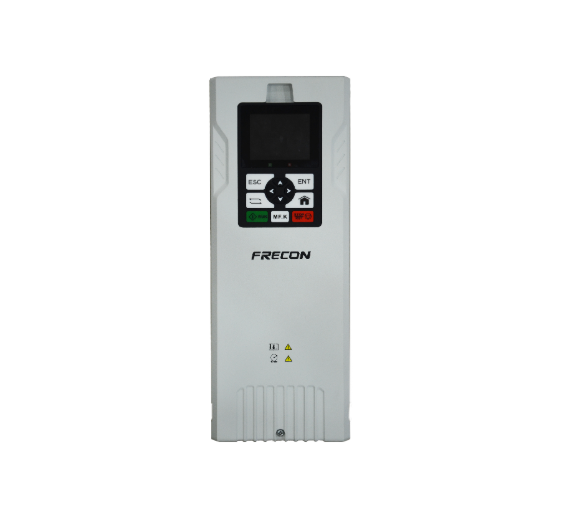
Industrial inverter functions can help address some of these issues. For example, the FR30 Series High Performance Inverter supplied by FRECON provides precise motor control, stable output, and configurable terminal functions. These features allow engineers to adapt control arrangements to different industrial motor applications.
Safety functions also deserve attention. The FR30 series includes standard built-in STO, or Safe Torque Off. When correctly integrated into a safety circuit, STO disables torque generation during hazardous situations and helps prevent unintended motor starting.
Electrical quality is another consideration. The series uses dual DC reactors for harmonic reduction and is designed to meet the EN61000-3-12 harmonic standard. Integrated EMC C2 filters support installation in electrically complex environments, while the series also complies with CE certification requirements.
Hydraulic Losses Should Not Be Ignored
Electrical efficiency cannot compensate for poor pipe design. Long pipelines, small pipe diameters, unnecessary bends, partly closed valves, and clogged filters increase resistance. The pump then requires more energy to deliver the same amount of water.
Pipe size should be selected according to required flow and allowable pressure loss. Engineers should also check elevation differences between the water source, pump, storage tank, and final delivery point. These factors directly influence total dynamic head.
Routine maintenance can prevent gradual efficiency loss. Sediment, worn impellers, blocked strainers, and leaking connections can reduce water output. Comparing flow rate and energy consumption over time can help operators identify changes before they become larger operating problems.
Storage and Monitoring Improve Daily Performance
Storage tanks make remote pumping systems less dependent on continuous sunlight. During strong solar periods, the pump can fill the tank. When generation declines, stored water can continue supplying irrigation or other applications without requiring immediate pumping.
Tank level sensors can be connected to suitable controls for automatic start and stop functions. Dry-run protection, pressure monitoring, and motor protection may also be considered according to the specific pump and water source.
Monitoring is useful for long-term performance evaluation. Operators can record daily water volume, operating hours, motor frequency, energy consumption, and fault events. These records make it easier to determine whether reduced output comes from solar conditions, hydraulic restrictions, or equipment problems.
System Integration Determines Practical Efficiency
Effective green energy solutions depend on coordination between solar generation, the inverter, motor, pump, pipeline, storage tank, and controls. Each component needs to match the electrical and hydraulic requirements of the project.
For motor-driven applications, FRECON provides the FR30 series as one option for variable-speed control. Project engineers still need to verify input conditions, motor specifications, safety design, and the intended control architecture before selecting a specific configuration.
Technical documentation should also be reviewed before procurement. Buyers can ask the Variable Frequency Drive manufacturer for wiring information, motor compatibility data, protection requirements, and commissioning guidance. This reduces uncertainty when equipment is installed at remote sites.
Efficiency Comes From Better System Matching
Efficient solar pumping systems are built around matching, not simply adding more solar panels. Pump selection, motor speed control, pipe design, storage capacity, and monitoring all affect how effectively available energy is converted into useful water delivery.
When electrical and hydraulic requirements are considered together, remote pumping projects can operate with fewer unnecessary losses and more predictable performance. Careful system design also makes later maintenance and performance evaluation easier for operators working far from conventional power infrastructure.


