PVC Extrusions for Cable Management in Data Centres: How Server Room Infrastructure Is Served
Data centres contain far more cable infrastructure than the visible server racks suggest. Power feeders, network links, control wiring, monitoring circuits, and security systems all require defined routes, physical separation, and accessible pathways. PVC extrusions can form conduit, trunking, protective profiles, and other cable-management components used around equipment rooms and raised-floor spaces.
The specification becomes more demanding when flame behaviour, electrical performance, installation density, and long-term dimensional stability are considered. DEKUMA develops extrusion equipment for PVC processing, including systems used for pipes and profiles across infrastructure applications.
Cable Routing in Dense Server Environments
Power and signal cables often occupy the same overall building zone while requiring different routing arrangements. Conduit can provide enclosed protection for individual cable groups, whereas trunking creates a more accessible channel for larger bundles. Raised-floor systems introduce another option, allowing cables to travel beneath equipment areas while remaining reachable during maintenance or expansion.
The geometry of an extrusion profile depends strongly on its intended installation method. A conduit requires controlled internal diameter and wall dimensions so that cables can pass through without excessive friction. Trunking profiles may instead depend on accurate cover engagement, corner geometry, mounting surfaces, and partition dimensions. Small dimensional deviations can become inconvenient when many sections must connect across a large server room.
Material selection adds another consideration. Data-centre cable routes can be exposed to heat generated by electrical equipment and may run through confined spaces where smoke and flame characteristics matter. Consequently, a profile specification should consider the applicable fire classification, temperature conditions, mechanical requirements, and installation environment rather than selecting PVC solely according to its basic polymer identity.
Flame Performance and Material Selection
Fire performance is particularly relevant in enclosed technical spaces. PVC compounds can be formulated with different additives and stabilizers, and the final behaviour depends on the complete formulation and profile construction. Requirements should be established from the applicable building, electrical, and fire-safety standards before the extrusion recipe is fixed.
Electrical separation presents a related challenge. Power conductors and data cables can occupy adjacent pathways, yet sensitive communication systems may be affected by electromagnetic interference from nearby electrical equipment. PVC itself is electrically insulating and does not function as a metallic electromagnetic shield. Where electromagnetic compatibility is important, cable type, routing distance, separation barriers, grounding arrangements, and dedicated shielding methods have to be considered alongside the plastic profile.
Material thickness also has practical consequences. A thicker wall may provide greater mechanical rigidity, but excessive material can increase weight, cost, and cooling demand. Profile designers instead need to identify where structural support is actually required and distribute material accordingly. Consistent wall dimensions become particularly valuable when long lengths of trunking or conduit must fit together across multiple installation zones.
Extrusion Control and Profile Consistency
A PVC pipe manufacturing machine can provide the basic extrusion platform for understanding how material throughput, haul-off speed, cooling, and dimensional control interact, even though cable-management profiles may require different tooling and downstream arrangements. Stable pulling is particularly important because the movement of the profile determines how much material is distributed over a given length.
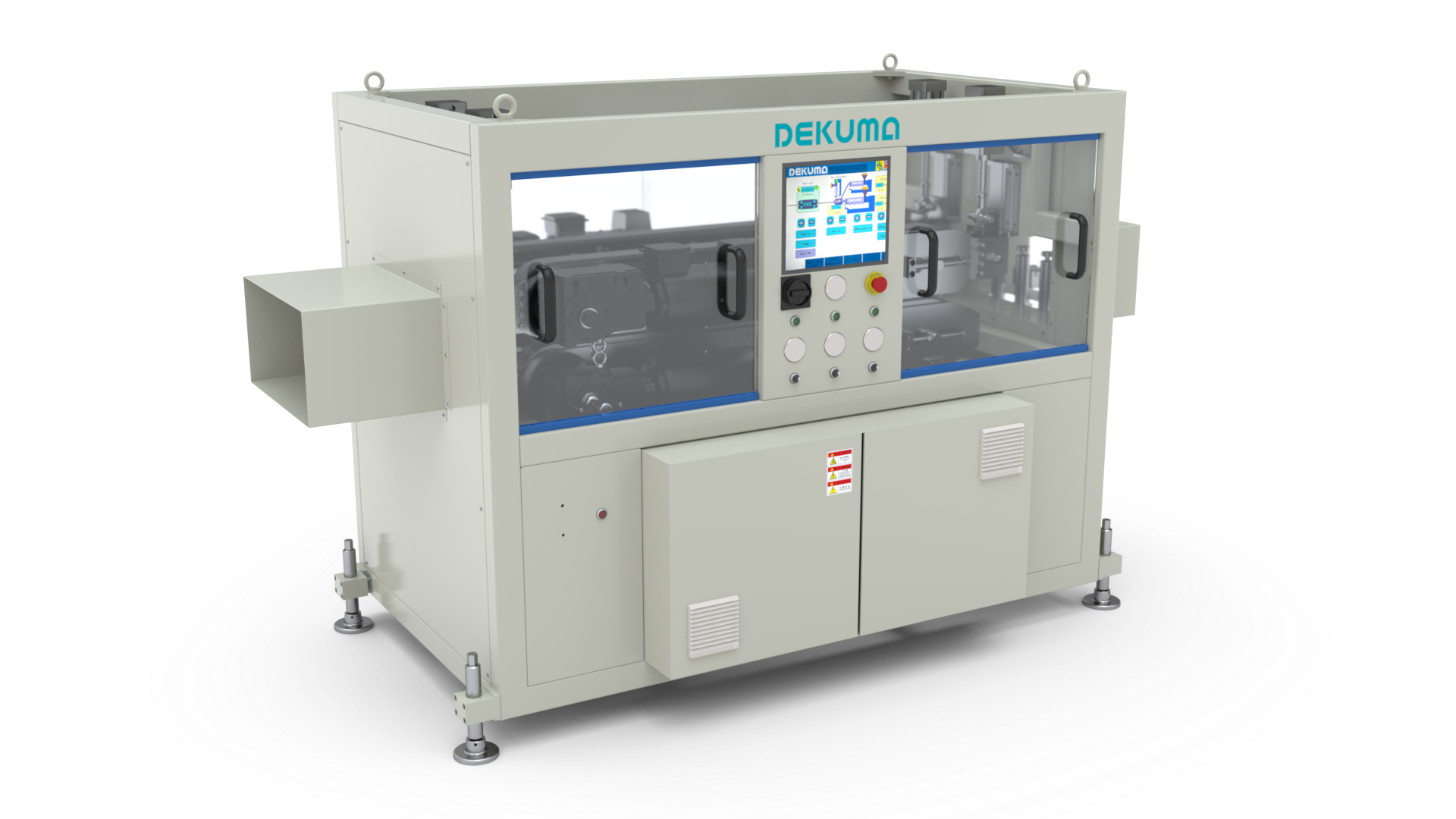
DEKUMA’s PVC extrusion equipment uses a caterpillar haul-off driven by an AC servo motor, allowing synchronized traction with the extrusion process. The upper caterpillar uses pneumatic flexible clamping to accommodate specification differences, while the lower section can be electrically adjusted to the required position. High-friction rubber pads provide traction, and configurations with two, three, four, six, or eight caterpillars are available for pipe diameters from 20 to 450 mm. These features illustrate how controlled downstream movement can influence dimensional consistency during continuous extrusion.
The same process principle matters when producing cable-management profiles. Excessive pulling can distort a soft profile, while insufficient traction may cause unstable movement through cooling and sizing equipment. Operators need to monitor the relationship between extrusion output and line speed rather than treating haul-off velocity as an independent setting. The correct operating window depends on compound behaviour, tooling geometry, cooling conditions, and the finished profile specification.
Designing Infrastructure for Future Expansion
Data centres rarely remain static after initial construction. Rack density can change, additional network connections may be installed, and electrical distribution can be modified as computing requirements evolve. Cable-management systems consequently benefit from accessible pathways and standardized dimensions that allow sections to be replaced, extended, or reorganized without extensive reconstruction.
This requirement affects profile design as much as material choice. Conduit intended for future cable installation needs sufficient internal clearance and manageable bends, while trunking may require removable covers or internal divisions. Raised-floor pathways also need to coexist with airflow management, structural supports, and access requirements. The cable-management component cannot be evaluated separately from the surrounding building system.
Conclusion
Cable management in a data centre is an infrastructure discipline rather than simply a matter of hiding wires. PVC extrusions can support several routing concepts, but their usefulness depends on the relationship between profile geometry, fire behaviour, electrical environment, mechanical loading, and future maintenance needs. Power and signal pathways may require different arrangements even when they occupy the same technical area.
From manufacturing to installation, PVC pipe manufacturing machine principles highlight the importance of coordinated material flow and downstream control. Profile-specific tooling, cooling, haul-off, and dimensional inspection must work together so that repeated sections retain the geometry required by the installation design. That consistency becomes increasingly valuable when hundreds or thousands of components are assembled across a large facility.
DEKUMA‘s extrusion equipment portfolio includes controlled traction systems and PVC processing technologies that can be adapted to infrastructure-oriented production requirements. The broader lesson is that PVC extrusions for server environments should be specified around the actual electrical, mechanical, fire-safety, and maintenance conditions of the data centre, while the manufacturing process should be structured to reproduce those requirements consistently from one production run to the next.


